DNA means “Did Not Attend” or “Did Not Answer”.
When an appointment is missed without enough notice, that appointment cannot always be offered to another patient. This can increase waiting times and reduce the number of appointments available.
We understand that sometimes appointments are missed for genuine reasons. Our policy is designed to help reduce repeated missed appointments while taking individual circumstances into account.
What counts as a missed appointment?
An appointment may be recorded as a DNA if:
- You do not attend a booked face-to-face appointment
- You arrive too late for the clinician to safely see you
- You do not answer a booked telephone appointment after the appropriate call attempts have been made
- You cancel too late for the appointment to reasonably be offered to another patient
Telephone appointments
For booked telephone consultations, please make sure:
- Your telephone number is up to date
- Your phone is switched on and available around the appointment time
- You are able to answer calls from a withheld or No Caller ID number
If the clinician is unable to reach you after the required call attempts, the appointment may be recorded as a DNA and you may need to rebook.
What happens if I miss an appointment?
We monitor missed appointments over a rolling 12-month period.
First missed appointment
We will record the missed appointment on your medical record and may send you a reminder about our DNA policy.
Second missed appointment
The missed appointment will be recorded and we may contact you to remind you of the importance of attending or cancelling appointments you no longer need.
Three or more missed appointments
If you have three or more DNAs within a rolling 12-month period, your circumstances may be reviewed by the practice.
This does not mean that you will automatically be removed from the practice.
We will consider the circumstances surrounding the missed appointments and any relevant information before deciding whether further action is appropriate.
Where repeated missed appointments continue without reasonable explanation, further action may be taken in accordance with practice and NHS guidance.
Cancelling an appointment
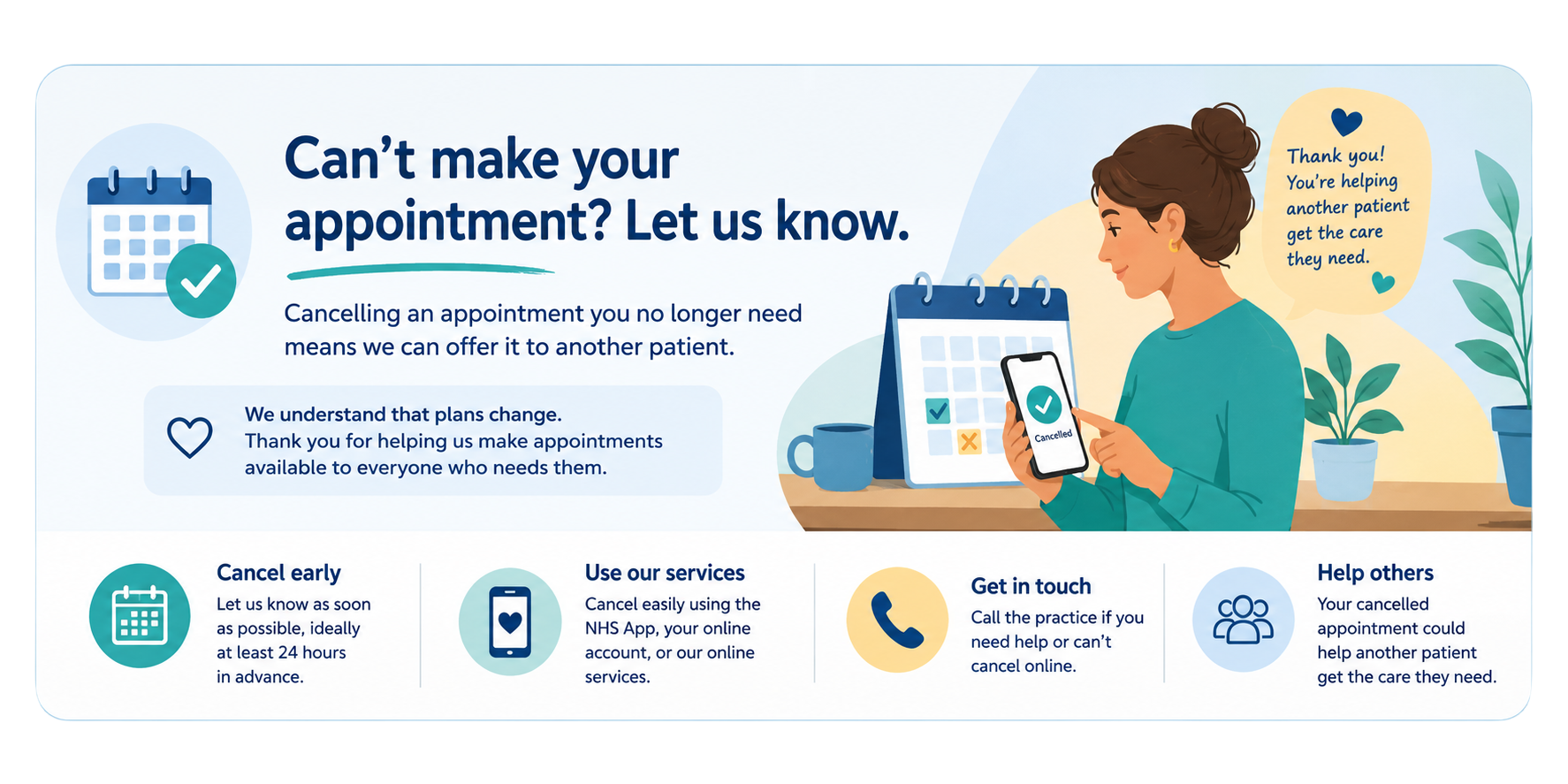
If you know that you cannot attend, please cancel as soon as possible so that we can offer the appointment to another patient.
Where possible, please give us at least 24 hours’ notice.
Depending on how your appointment was booked, you may be able to cancel using:
- The NHS App
- Your online account
- A cancellation link in your appointment reminder
- Our online services
- By contacting the practice
Even if it is less than 24 hours before your appointment, please still let us know rather than simply not attending.
Running late?
If you think you are going to be late, please contact us as soon as possible.
Arriving late may mean that the clinician no longer has enough time to safely complete your consultation. Depending on how late you arrive and the circumstances, you may need to rearrange your appointment.
We understand that things happen
We recognise that there can be genuine reasons for missing an appointment, including illness, emergencies, caring responsibilities or other unexpected circumstances.
When reviewing repeated missed appointments, the practice will take relevant individual circumstances into consideration.
If you believe an appointment has been incorrectly recorded as a DNA, or there were circumstances you think we should know about, please contact the practice.
Help us make appointments available to everyone
You can help by:
- Attending appointments you have booked
- Cancelling as early as possible if you no longer need an appointment
- Keeping your contact details up to date
- Being available for booked telephone consultations
- Contacting us if circumstances prevent you from attending
Cancelling an appointment you no longer need means we may be able to offer it to another patient.